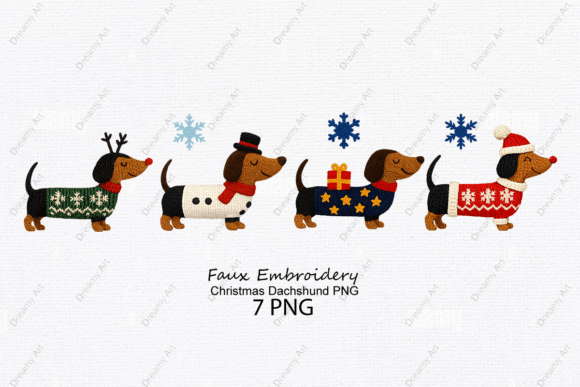
Faux Embroidery Christmas Dachshund PNG
A Designer’s First Glance: Charm, Clarity, and Holiday Warmth
When I opened the Faux Embroidery Christmas Dachshund PNG, my first thought wasn’t “cute”—it was “usable.” That’s rare. So many holiday illustrations lean into cluttered whimsy or over-rendered detail, but this one lands with quiet confidence: a dachshund wearing a tiny red-and-green scarf, standing on a soft snow-dusted base, eyes bright, posture playful but grounded. The faux embroidery texture is subtle—not photorealistic stitching, but clearly *suggestive* of satin stitch contours and gentle fill gradients. It reads as handmade without sacrificing clean edges or scalable clarity. For a designer evaluating real-world embroidery projects, that balance is everything.
Where This Design Naturally Lives—And Thrives
I tested the Faux Embroidery Christmas Dachshund PNG in mockups for three actual small-batch products: a linen tea towel for a local boutique, a cotton baby onesie for a holiday gift set, and a 4-inch embroidered patch for a craft fair tote bag line. In every case, it held up—not just visually, but conceptually. Its moderate size (no sprawling limbs or ultra-thin antennae), balanced negative space, and clear silhouette mean it translates cleanly from screen to stitch. Unlike some holiday graphics that vanish on dark fabric or blur on textured weaves, this design carries weight and recognition at 3–5 inches wide. It’s ideal for sweatshirt embroidery, tote bag design, and holiday gifts where charm and legibility matter more than intricate realism.
Real-World Stitching Considerations—What Works, What Needs Care
Because this is a PNG—not a machine embroidery file—the real work begins with conversion. As a designer who regularly turns illustrations into machine embroidery designs, I treated the Faux Embroidery Christmas Dachshund PNG like raw material: assessing line weight, interior detail density, and edge definition before digitizing. The scarf’s folds? Clean enough for smooth satin stitch. The dachshund’s ears? Sufficiently separated from the head to avoid nesting or thread buildup. But the tiny paw details? Those would need simplification for reliable applique design or dense fill stitch execution—especially on stretchy fabric or curved surfaces like caps.
It performs best on stable, medium-weight fabrics: cotton twill for patches, midweight fleece for sweatshirts, tightly woven linen for tea towels. On thin or highly textured fabrics, I’d reduce stitch density in the conversion stage and add lightweight cutaway stabilizer. And while the transparent background makes layering easy for printable mockups, remember: the final embroidered patch or custom apparel will rely entirely on your digitizing choices—so always test on scrap fabric first.
How It Elevates (or Undermines) Your Finished Product
This isn’t just decoration—it’s brand language in miniature. When used thoughtfully, the Faux Embroidery Christmas Dachshund PNG adds instant warmth and approachability to handmade product listings. Etsy sellers told me customers specifically mentioned “that friendly dachshund” when reordering holiday kitchen towels. Why? Because it feels personal, not mass-produced—and that builds customer trust. But misuse erodes that effect fast. Slapping it onto a low-stabilized baby onesie without adjusting stitch angles can lead to puckering; scaling it too large on a curved cap brim risks distortion. The design’s strength lies in its restraint—so honor that in your embroidery project planning.
Practical Notes Every Designer & Seller Should Keep Handy
- Always test on scrap fabric—especially if pairing with dark thread on light fabric or vice versa. The faux texture implies contrast; verify it delivers.
- Review stitch density early. The original PNG suggests soft fills—but dense fill stitch on small areas (like the scarf stripe) may require underlay or reduced density for breathability.
- Confirm hoop size compatibility before digitizing. The composition fits comfortably in a 4×4 hoop, but check proportions if adapting for larger formats like pillow covers or blankets.
- Inspect small details at 100% zoom. The nose, eye highlights, and scarf fringe are delicate. Some may need slight thickening for reliable satin stitch execution.
- Test black-and-white mockups. Does the shape hold up without color cues? Yes—with this design, it does. That’s a sign of strong visual hierarchy.
- Compare light and dark fabric backgrounds. The transparent PNG gives you flexibility, but thread color selection must support readability on both.
- Use proper stabilizer—especially for baby embroidery or items requiring frequent washing. A lightweight tear-away works for cotton; cutaway adds durability for fleece or knits.
- Verify licensing before commercial use. Since this is listed as Illustrations and Graphics, confirm whether resale of finished embroidered items or digital embroidery files is permitted.
Final Thought: A Thoughtful Tool, Not a Magic Button
The Faux Embroidery Christmas Dachshund PNG won’t replace skilled digitizing or thoughtful fabric selection—but it *does* give you a strong, holiday-ready foundation. It’s the kind of design asset that saves time without sacrificing character: warm enough for nursery decor, crisp enough for boutique branding, simple enough for craft fair speed—but never generic. If you’re curating digital embroidery files for your craft business, building an Etsy seller collection, or designing small shop product lines, this is the kind of illustration that earns repeat use. Just remember: great embroidery starts with smart choices—not just pretty pixels.