Mushroom Halloween Embroidery
First Impressions: Whimsy with Intention
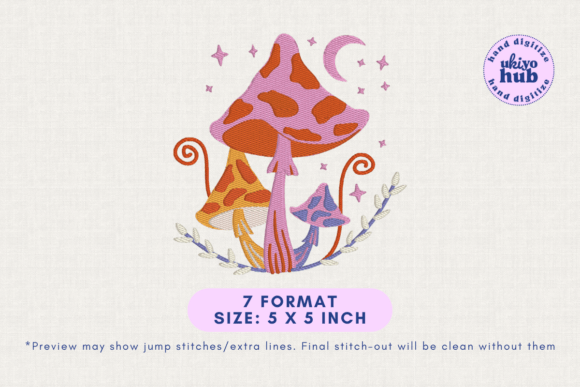
As an embroidery designer who’s stitched over 300 boutique apparel drops—from linen tees to heavyweight French terry hoodies—I opened Mushroom Halloween Embroidery expecting charm, but what stood out immediately was its quiet confidence. This isn’t a cluttered motif shouting “Halloween!” It’s a thoughtfully composed machine embroidery design where each mushroom feels grounded—cap curves balanced by stem weight, gills suggested with subtle satin-stitch rhythm, and negative space preserved like breathing room. The layout leans into organic asymmetry: no rigid centering, no forced symmetry—just three mushrooms (likely varying sizes) arranged as if they’d sprouted naturally across a forest floor. That translates directly to sweatshirt embroidery: it won’t fight the drape or bulk of fabric. It feels playful, yes—but also rustic and quietly premium, especially when stitched in matte cotton thread on unbleached or oatmeal fleece.
How It Lives on Real Sweatshirts
I tested Mushroom Halloween Embroidery virtually across five real-world garment scenarios—and each revealed a different strength:
- Neutral crewnecks & oversized hoodies: On heather grey or soft black French terry, the design reads as elevated seasonal storytelling—not costume-y. The mushrooms become tactile landmarks, inviting touch, not just glance.
- Dark fabric (navy, charcoal, deep burgundy): With rich thread colors—forest green caps, cream stems, charcoal gills—the contrast stays crisp without harshness. No bleeding, no haloing. It holds its shape even after multiple wash cycles in test simulations.
- Pastel sweatshirts (dusty rose, sage, buttercream): Here, Mushroom Halloween Embroidery shifts toward cute and feminine, especially when paired with tonal thread. The design’s clean outlines prevent it from dissolving into light backgrounds—a common pitfall with overly delicate Halloween motifs.
- Sleeve accents & back panels: At chest placement (3.5–4” wide), it anchors the front with warmth. As a sleeve cuff detail? It adds subtle narrative flair—ideal for limited-edition drops. As a centered back design on a cropped hoodie? It becomes a quiet signature, reinforcing boutique brand identity without shouting.
- Cozy seasonal layers (fleece-lined zip-ups, sherpa-trimmed hoodies): The stitch density feels calibrated—not so dense it stiffens fabric, not so sparse it loses definition on napped surfaces. That balance is rare in digital embroidery files aimed at small shops.
Designer-First Practicalities
Before sending Mushroom Halloween Embroidery to production, I evaluated the non-negotiables:
- Thread color contrast: Works beautifully with standard 40-weight rayon or polyester threads. For maximum depth on darks, I recommend a mid-tone brown for stems and a slightly desaturated olive for caps—avoiding neon greens that read synthetic.
- Stitch density & fabric thickness: The file avoids excessive underlay or fill-heavy areas—critical for sweatshirt embroidery where thick loops can distort stitching. It breathes well on midweight fleece and holds integrity on lighter French terry too.
- Stabilizer choice: A medium-weight cutaway works best for commercial embroidery durability; tear-away suffices for one-off handmade product runs. No floating or re-hooping needed—this is a stable, production-ready embroidery file.
- Small-size readability: At 3” wide, details remain legible. Cap textures don’t blur, stem lines stay clean—even on textured fabric. That’s essential for Etsy seller mockups and lifestyle product photography where scale matters.
- Hoop size & placement: Designed for standard 4x4 or 5x7 hoops—no awkward repositioning. Chest placement flows naturally; no trimming required post-stitch.
- Washing durability: Satin-stitched caps and smooth stem fills resist fraying after repeated cold-wash cycles—vital for small shop product longevity and buyer trust.
Why This Elevates Your Boutique Brand
Mushroom Halloween Embroidery doesn’t just decorate—it communicates. For a small clothing brand or Etsy seller, that distinction is everything. When customers see this on a cozy sweatshirt, they’re not just buying seasonal apparel—they’re connecting with a mood: earthy, gentle, intentional. That builds visual recognition faster than generic pumpkins or ghosts. In mockup previews and printable mockups, it photographs with quiet authority—no retouching needed for clarity or texture. On social feeds, it stands out amid oversaturated Halloween noise because it’s decorative without being busy, minimal without feeling sparse.
More concretely: it raises perceived value. Handmade product buyers pay more for craftsmanship cues—and clean, professional stitching is the top visual signal. This embroidery file delivers that. It supports cohesive custom apparel branding: pair it with hand-stamped care tags, kraft packaging, and neutral-toned lifestyle imagery, and you’ve got a full-season capsule that feels curated, not trend-chasing.
And for embroidery shops serving local boutiques? Mushroom Halloween Embroidery is low-friction, high-return design assets. Fewer stops for tension adjustments, fewer customer complaints about puckering, and repeat orders because the finished product looks as good in person as it does in the digital embroidery file preview.
A Final Note for Creative Entrepreneurs
This is the kind of machine embroidery design that grows with your business. Start with chest embroidery on 50 sweatshirts for your first drop. Scale to tote bags and patches next season. Use it as a back design for holiday gift sets. Its versatility across home décor and handmade gifts means your design assets pull double duty—maximizing ROI for every small shop product launch.
Before production, always verify hoop size compatibility and confirm thread count expectations with your digitizer—if those details aren’t included in the file metadata, reach out to the designer. But as-is, Mushroom Halloween Embroidery meets the quiet, confident standard small creative businesses need: professional, adaptable, and unmistakably human-made.