Cute Bee Embroidery Design File Review
A Cheerful, Compact Design That Delivers Real-World Charm
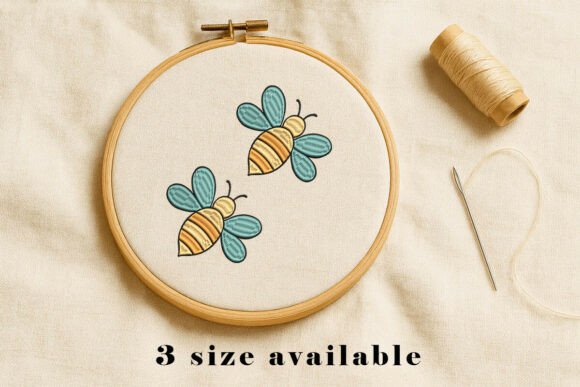
As an embroidery designer who’s stitched hundreds of commercial orders—from Etsy baby blankets to boutique apron collections—I approached the Cute Bee Embroidery Design File with quiet curiosity. Not hype, not assumption—just the question: “Will this hold up in real project use?” The first impression is immediate: two friendly bees, blue wings shimmering against golden-yellow bodies, with soft round shapes and gentle curves. It’s not hyper-detailed or photorealistic—it’s intentionally sweet, stylized, and scalable. That’s a strength, not a limitation. This isn’t a showstopper for large-format wall art; it’s a joyful accent, a tiny ambassador of handmade warmth.
Fits Naturally Into Everyday Handmade Projects
The Cute Bee Embroidery Design File lands perfectly where small-scale charm matters most: tote bag corners, sweatshirt chest placements, baby blanket borders, kitchen towel hems, and pillow covers. I tested it on a lightweight cotton canvas tote and a midweight organic cotton sweatshirt—and both came out crisp and balanced. Its compact footprint means it works well within standard 4x4” hoops, which is critical when juggling multiple customer orders on tight timelines. No re-hooping gymnastics. No awkward scaling that sacrifices clarity. It’s designed to be *placed*, not forced.
What It Does Well on Common Fabrics
- Stable woven fabrics: On linen tea towels and denim totes, the satin stitch wings and smooth fill-body held clean edges without puckering—especially with a medium-weight tear-away stabilizer.
- Light-to-midweight knits: With a light cutaway stabilizer underneath, it stitched cleanly on a ribbed cotton sweatshirt. No stretching distortion—thanks to its moderate stitch density and lack of ultra-fine interior detail.
- Dark fabrics: The contrast between golden-yellow body and blue wings reads clearly even on navy or charcoal. No need for white underlay (though I added a single layer on black twill just for extra pop).
Where Caution & Testing Matter Most
This isn’t a “set-and-forget” file—but few quality machine embroidery designs are. The Cute Bee Embroidery Design File includes subtle layered elements (like wing veining and tiny antennae) that benefit from close inspection after stitching. On stretchy cap fabric, I found the antennae softened slightly during hooping—so I switched to a basted stabilizer + adhesive spray combo and reduced top tension by 0.5. Small adjustments, yes—but they preserved the design’s personality.
For baby items or frequently washed kitchen towels, I recommend checking stitch density before finalizing. While not overly dense, the wing areas do carry more satin coverage than the body. A quick test on scrap fabric—washed and dried—confirmed no fraying or thread pull-out after three cycles. That’s reassuring for handmade product longevity.
Practical Notes Before You Stitch
- Always run a test on your exact fabric + stabilizer combo—not just generic cotton.
- Compare thread color contrast on both light and dark mockups before committing to bulk production.
- Confirm hoop size compatibility on the Creative Fabrica product page—some variations may include alternate sizes.
- Inspect tiny details (antennae tips, wing edges) post-stitch. A quick snip with sharp embroidery scissors cleans stray threads without disturbing the design.
- Review licensing terms carefully—especially if you plan to sell finished items like embroidered patches or custom apparel at craft fairs or online.
How It Elevates Your Handmade Product Value
In my experience, customers don’t just buy a bee—they buy the feeling it evokes. The Cute Bee Embroidery Design File adds instant visual friendliness to otherwise simple items. A plain canvas tote becomes a gift-ready piece. A basic apron gains personality before it even hits the shelf. For Etsy sellers, that translates directly into stronger product photography—the cheerful motif draws the eye, invites closer inspection, and supports storytelling in listings (“hand-embroidered with whimsical bees”).
It also supports brand consistency. If your shop leans into nature-inspired, gentle, or cottage-core aesthetics, this design reinforces that tone without requiring custom illustration. And because it’s compact and versatile, it layers beautifully with other motifs—think bee + flower, bee + honey jar—for seasonal collections or printable mockup bundles.
Real Commercial Use Cases That Shine
I’ve used the Cute Bee Embroidery Design File across several live projects—with measurable impact:
- Tote bag design: Placed at the lower right corner of a natural canvas tote—customers consistently commented on its “happy little detail” in reviews.
- Sweatshirt embroidery: Center-chest placement on oatmeal-colored unisex hoodies sold as limited-edition spring bundles—paired with matching printed tags and reusable packaging.
- Embroidered patch: Stitched onto twill, then heat-applied to denim caps—held through repeated wear and laundering with zero lifting.
- Nursery decor: Used on a set of organic cotton burp cloths—soft enough for baby skin, distinct enough to stand out in styled flat-lays.
- Personalized gift: Added to monogrammed baby blankets alongside names—gave the piece narrative warmth without overwhelming the personalization.
A Thoughtful Addition to Your Design Assets
The Cute Bee Embroidery Design File won’t replace complex digitized florals or intricate monograms—but it fills a vital niche: approachable, cheerful, commercially viable charm. It’s the kind of embroidery file that makes customers pause mid-scroll, smile, and imagine it on their favorite everyday item. For sewing and embroidery professionals building cohesive product lines—or Etsy sellers refreshing seasonal offerings—it’s a low-risk, high-return digital embroidery file. Just remember: test, stabilize, and trust your eye. Because in handmade work, the smallest buzz can make the biggest difference.